
A capacity example before you rent a server
If 200 viewers each receive a 6 Mbps stream, the payload egress is approximately 1,200 Mbps, before protocol overhead and spare capacity. A single 1 Gbps port cannot carry that workload continuously. This arithmetic is a planning example, not a benchmark of any provider.
Distinguish an average from a peak: a quiet afternoon test does not size a simultaneous event. Track active viewers, aggregate throughput, startup failures, origin response time and dropped sessions together. A server with idle CPU can still be limited by its network or origin.
One failed hop can look like a failed player
Trace the full playback chain: entry URL, redirect, manifest, child playlist and media segment. Confirm each required host has valid HTTPS and that browser access is allowed where appropriate. A working login endpoint does not prove that the segment host works.
Keep credentials out of public logs and screenshots. Use narrowly scoped operator access and document a rollback before changing playback paths. Obtain the necessary distribution permissions from the content owner; a working stream URL does not establish them.
Scope and disclosure: This is an educational infrastructure guide for streams you own or are licensed to distribute. It does not provide sources, credentials, channel lists or instructions for bypassing access controls. BexyTV operates this website and offers a reseller program; this article does not claim that BexyTV sells raw restream feeds.
What is an IPTV restream?
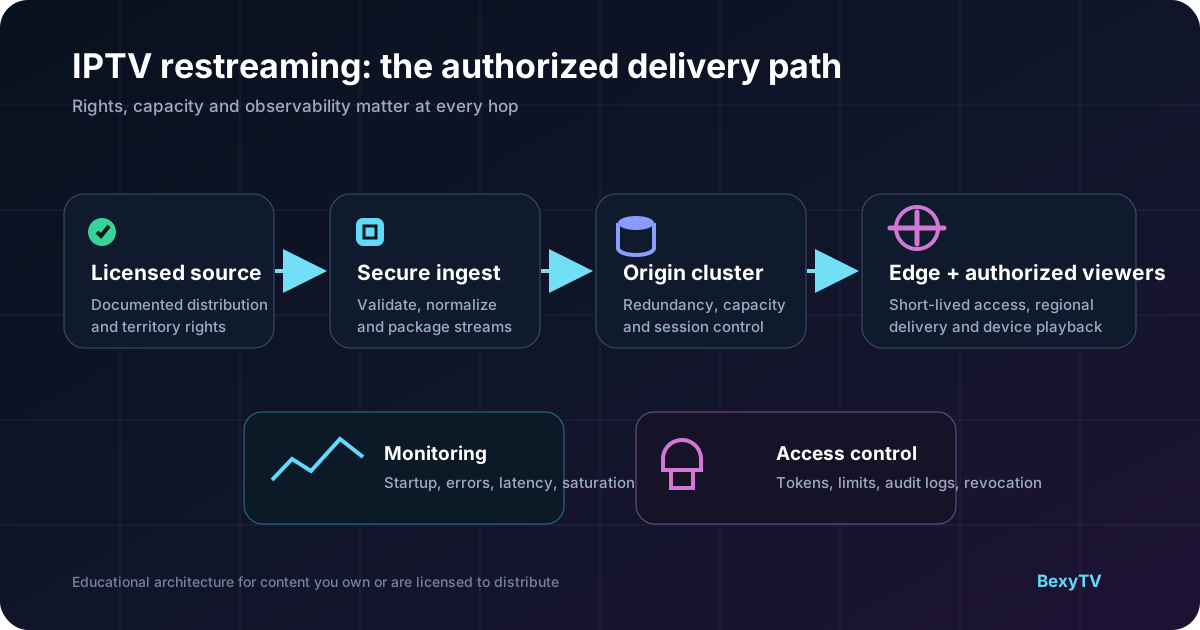
An IPTV restream takes an incoming live feed, processes or packages it where necessary, and serves it to authorized downstream viewers. Search phrases such as IPTV restream server, IPTV restream panel and IPTV restream provider describe different parts of that same operating model:
- Source: the original contribution feed and the contract that permits its use.
- Ingest: the controlled entry point that validates, normalizes and packages the stream.
- Origin: the server or cluster that holds the authoritative live output.
- Edge delivery: regional nodes or a CDN that reduce distance and origin load.
- Control plane: the panel, API, authentication, connection limits and audit trail.
- Observability: startup time, errors, bitrate, saturation and end-to-end availability.
A panel can make accounts and display statistics, but it cannot repair an unstable source, add missing distribution rights or create network capacity. Judge the complete delivery path rather than the dashboard alone.
IPTV reseller vs restream operator vs CDN
| Model | Main responsibility | Infrastructure burden | Questions to settle |
|---|---|---|---|
| Reseller | Provision accounts supplied by another platform | Low to moderate | Branding, support, pricing, customer terms |
| Restream operator | Operate or contract the live delivery chain | High | Rights, sources, capacity, security, incidents |
| CDN customer | Use a delivery network for owned or licensed streams | Moderate | Egress, regions, cache behavior, service levels |
| Content owner | Control the programming and authorize distribution | Varies | Territory, platforms, windows, downstream rights |
The key distinction is control. A reseller may never touch the video path. A restream operator makes decisions that affect every viewer and can carry obligations for copyright, privacy, security, uptime and data handling.
Legal checks come before server checks
The technology does not decide whether a deployment is lawful. Rights do. The U.S. Copyright Office has explained that Internet retransmission of copyrighted broadcast programming generally requires the consent of copyright owners unless a relevant license applies. Its guidance also identifies unauthorized retransmission as a potential infringement of the public-performance right.
Before an IPTV restream goes live, keep a rights record for every source:
- Identify the rights holder. A login or reachable URL is not proof of redistribution authority.
- Define the territory. Rights may be limited by country, state, language or platform.
- Define the audience. Internal viewing, hospitality, consumer subscriptions and wholesale distribution are different uses.
- Check the term and window. Record start, end, blackout and event-specific restrictions.
- Confirm downstream rights. Permission to view or receive a feed is not necessarily permission to resell it.
For high-value or multi-territory distribution, have qualified counsel review the contracts. Primary references include the U.S. Copyright Office statement on Internet retransmission and its statement on illegal streaming.
IPTV restream bandwidth: calculate the peak first
Bandwidth is usually the first hard limit. A practical planning estimate is:
If 100 viewers each receive a 6 Mbps stream, the video payload is 600 Mbps. Adding 15% operating headroom produces a target of about 690 Mbps. If that load ran continuously for 30 days, it would approach 224 TB of transfer. It probably will not run continuously, which is why peak concurrency and average monthly usage must be modeled separately.
Determines whether the network link can serve the busiest minute without saturation.
Drives variable egress cost and can exceed the server rental by a wide margin.
Multiple renditions improve device fit but add encoding, storage and origin work.
Active accounts are not simultaneous viewers. Measure the actual overlap by event and region.
Do not buy a server from CPU and RAM alone. Confirm committed bandwidth, port speed, transfer allowance, overage price, routing, DDoS policy and whether the provider permits your documented media workload.
What creates IPTV restream delay?
Live latency is cumulative. Contribution encoding, network transit, ingest analysis, transcoding, segment creation, playlist depth, CDN behavior and player buffering all add time. Moving an origin closer may reduce one part while an oversized player buffer keeps total delay unchanged.
| Stage | What to measure | Typical tradeoff |
|---|---|---|
| Source to ingest | Packet loss, jitter, source timestamps | Less buffering can expose source instability |
| Packaging | Segment duration and playlist depth | Shorter segments lower delay but raise request frequency |
| Origin and edge | First-byte time, cache hit rate, saturation | Aggressive caching may conflict with live freshness |
| Player | Startup time, buffer length, rebuffer ratio | A shallow buffer is faster but less tolerant |
Measure glass-to-glass delay with a visible clock or known live marker, then timestamp each stage. Changing several buffer values at once makes it impossible to know which change helped.
Reliability: monitor the viewer experience, not only the server
An IPTV restream server can show low CPU while viewers still see failures. Build monitoring around the path they use:
- source freshness, timestamp continuity and audio presence;
- playlist and segment availability from more than one region;
- startup time, failed starts, rebuffer ratio and playback errors;
- origin CPU, memory, disk, network and open-file saturation;
- edge hit ratio, egress, HTTP status patterns and upstream timeouts;
- authentication failures, concurrent sessions and unusual token reuse.
Define a service objective in viewer terms, such as successful starts and acceptable rebuffering during peak time. “The box responds to ping” is not a video service level.
Security checklist for an IPTV restream panel
- Encrypt every public hop. Use TLS and keep control APIs away from plaintext endpoints.
- Use short-lived access. Signed URLs or tokens should expire and support revocation; avoid permanent credentials in playlists.
- Separate the control and video planes. A panel compromise should not automatically expose origin administration.
- Apply least privilege. Operators, resellers and support staff should receive only the permissions required for their role.
- Protect logs and personal data. Set retention limits and never record passwords, full tokens or unnecessary customer identifiers.
- Practice incident response. Test credential rotation, source isolation, token revocation, backups and customer communication.
How to evaluate an IPTV restream provider
Do not begin with “How many channels?” Begin with evidence. A legitimate technical vendor should be willing to define what it provides and what remains your responsibility.
| Ask for | Good evidence | Red flag |
|---|---|---|
| Authorization | Named rights holder, territory and permitted use | “Private source” or refusal to discuss rights |
| Capacity | Committed port, transfer terms and tested concurrency | “Unlimited” with no technical boundary |
| Availability | Written measurement method and incident history | Perfect-uptime promises |
| Security | Token model, roles, audit logs and response process | Shared administrator credentials |
| Exit terms | Data export, deletion, termination and migration terms | No documented way to leave |
| Trial | Limited test using authorized sample content | Production credentials sent in open chat |
Build, buy or use a reseller platform?
Fits teams with licensed content, streaming engineering, monitoring and enough scale to justify operating the stack.
Fits rights holders that want contractual capacity and support without operating every video component.
Fits sales and support teams that need account provisioning rather than ownership of video infrastructure.
If your actual requirement is customer provisioning, an IPTV reseller program is operationally different from running an IPTV restream server. Do not accept the legal and engineering burden of an origin network when the business only needs a controlled reseller account.
IPTV restream frequently asked questions
What is IPTV restreaming?
It is the controlled receipt and redistribution of a live video stream through additional infrastructure. A lawful deployment starts with owned or licensed content, then uses ingest, origin, edge delivery, authentication and monitoring to reach authorized viewers.
Is IPTV restreaming legal?
The technology has lawful uses, but authorization is decisive. Restreaming copyrighted programming without the required content, territory and distribution rights can infringe copyright. Document every source and obtain legal advice for the markets you serve.
What is the difference between an IPTV reseller and a restream operator?
A reseller normally provisions accounts inside a supplier's platform. A restream operator handles or contracts for ingest, origin, bandwidth, authentication and monitoring, creating much greater technical, financial and legal responsibility.
How much bandwidth does an IPTV restream server need?
Estimate peak Mbps as average delivered bitrate times simultaneous viewers times about 1.15 for headroom. One hundred viewers at 6 Mbps each produce a planning target near 690 Mbps. Also model monthly transfer and provider overage charges.
Does a restream server reduce live delay?
Not automatically. Better routing and regional delivery can help, but ingest, packaging, playlists and player buffering all add time. Measure end-to-end delay and change one stage at a time.
What should an IPTV restream provider disclose?
Ask for documented authorization, territories, source ownership, capacity limits, formats, authentication, log retention, incident response, service levels, data processing, exit terms and a secure test method.